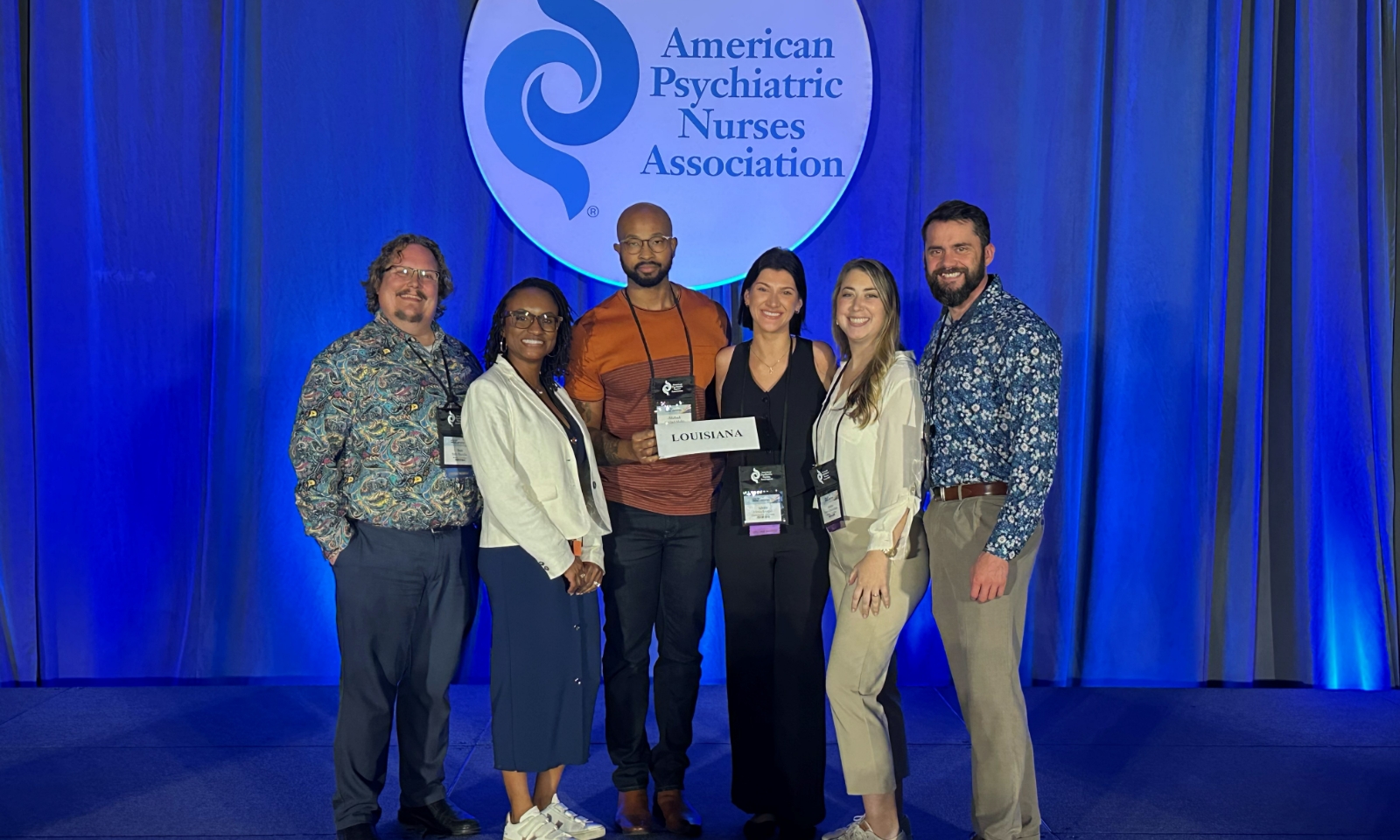
In October 2025, psychiatric-mental health nurses from across the country gathered in New Orleans for the American Psychiatric Nurses Association’s (APNA) 39th Annual Conference, held October 15–18 with the theme “Empowered to Innovate and Collaborate: PMH Nurses Shaping Care Excellence.”
For faculty members at the LSU Health Sciences Center New Orleans School of Nursing, the experience offered not only new insights into the future of psychiatric nursing but also reaffirmed their passion for preparing the next generation of nurses.
Mark Lanpher, RN, PMH-BC, Instructor of Undergraduate Nursing, Psychiatric Mental Health, attended the conference and says the experience was both energizing and reaffirming.
“This was my third time attending. I’ve been there as a student, as a nurse, and now as an educator – and every time, I’ve found sessions that match my current role and make me better at what I do,” he says.
Exploring New Approaches to Psychiatric Care and Education
Lanpher was particularly drawn to sessions exploring alternative and complementary treatments for managing psychiatric issues.
“I worry that often in this country, we’re too focused on a pill to fix issues that could be managed through lifestyle changes,” he says.
He was inspired by educators who are rethinking how to reach today’s students. Back on campus, he wasted no time turning that inspiration into action.
“I’ve already been talking with the other mental health faculty about bringing some new simulation scenarios to our course,” he says.
These simulation-based learning experiences would allow students to engage more deeply with psychiatric concepts that can be difficult to observe in clinical settings due to safety limitations.
Expanding Innovation Through Technology and Collaboration
Sam Mauldin, PhD, RN, PMH-BC, Instructor of Clinical Nursing and an ANCC Certified Psychiatric-Mental Health Nurse, also attended the APNA conference. He noted how much the field is evolving, especially in the integration of new technologies and student-centered teaching methods.
“Collaborating with other instructors throughout the nation allowed me to pick their brains and come up with new ideas on how to reach this new generation of learners.”
– Mark D. Lanpher, RN, PMH-BC, Instructor of Undergraduate Nursing
“What stood out to me was the breadth and diversity of knowledge presented,” Dr. Mauldin says. “There were student-focused programs, veteran-focused programs, and provider-focused programs. The use and integration of AI was discussed, as was the shift to competency-based education.”
For Dr. Mauldin, the sessions specifically geared toward undergraduate education and mental health clinicals were particularly valuable.
“There were some very good ideas about pre- and post-conference clinical experiences as well as flipped classroom discussions,” he says. “I plan to integrate those strategies into my lectures and clinical teaching.”
He adds that School of Nursing faculty are already collaborating on ways to advance mental health nursing simulation experiences, including a move toward immersive virtual reality.
“We’re working with Dr. Aimme McCauley to upgrade our mental health nursing simulations for students,” Dr. Mauldin says. “We’re hoping to transition from the vSim program to simulations utilizing virtual reality headsets soon. The integration of competency-based education, AI and virtual reality will change the way we present some material and greatly improve the student learning experience.”
Connecting Educators and Advocates Nationwide
The APNA conference also provided valuable opportunities for networking, both within Louisiana and across the country.
“This conference provided superb networking within the state and nationally,” Dr. Mauldin says. “We were able to discuss national and regional topics of interest and even begin planning upcoming events at the state level. It was very valuable to meet face-to-face.”
Lanpher echoed this sense of community and collaboration.
“Collaborating with other instructors throughout the nation allowed me to pick their brains and come up with new ideas on how to reach this new generation of learners,” he says. “I left feeling inspired by their innovative ideas and ready to bring them back to our undergraduate psych nursing curriculum.”
Supporting Student Wellness and Connection
In addition to exploring emerging educational innovations, both faculty members emphasized the ongoing importance of supporting student mental health.
Dr. Mauldin says that simple, proactive communication can make a meaningful difference.
“Some students may be hesitant to ask for help even when they’re in dire need of assistance,” he explains. “Proactively checking in with students, actively listening, and using an empathetic tone of voice can help them feel heard and supported.”
This student-centered mindset reflects the same holistic approach that drives LSU Health Sciences Center New Orleans’ Be Well initiative, one that prioritizes academic and emotional wellness alongside professional growth.
Inspiring the Future of Psychiatric Nursing
The APNA conference left both educators with a renewed sense of purpose and possibility.
For Lanpher, it reinforced his commitment to innovation and collaboration in the classroom. For Dr. Mauldin, it illuminated how emerging technologies and human connection can work hand in hand to strengthen psychiatric nursing education.
Together, their reflections capture the spirit of the conference and the mission of LSU Health Sciences Center New Orleans School of Nursing: to prepare compassionate, forward-thinking nurses who are empowered to innovate, collaborate and lead in shaping care excellence.